
Although we don’t know much about what extra-solar planets actually look like, and we know very little about the planets in our own system (we know a little about the Moon, Mars, and Saturn), there are places right here on earth that seem to belong to another world, places where they seem to violate the laws of nature and with a strange variety of colors in their extravagant geological formations.
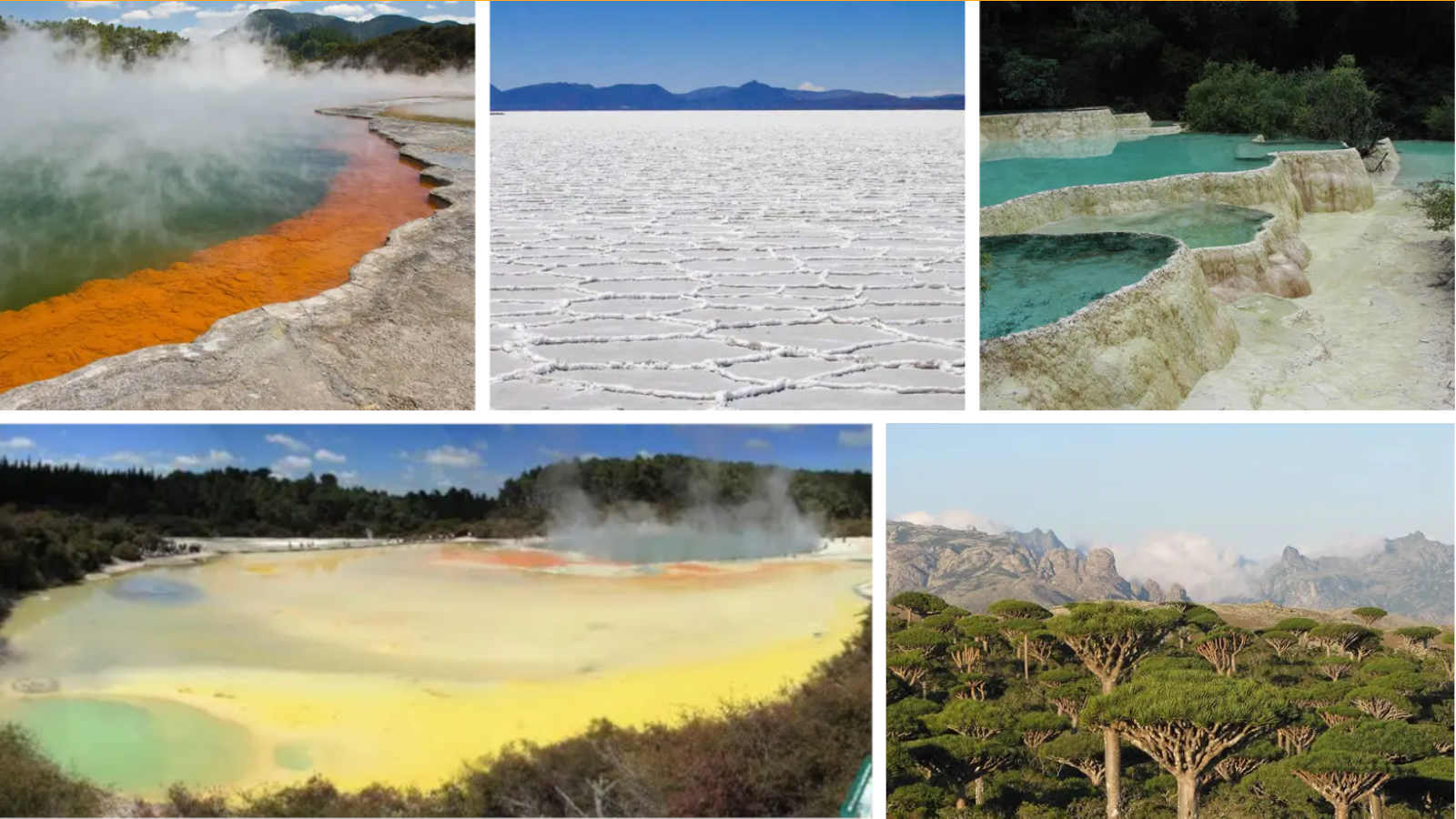
The chemical of our planet formed, with incredible patience, spaces that for some strange reason remind us of everything but what we know as part of us. All of them have something strange, something beautiful and attractive. These images are an example of the sites we are referring to.
1. Richat structure. Also known as the Eye of the Sahara, it is a circular structure in the Sahara Desert near Ouadane, Mauritania.
Via: NASA
Via Google Maps
2. Etosha Pan, Namibia. Similar to Saturn’s largest moon, Titan. Titan’s shallow hydrocarbon lakes behave like a salt lake on earth.
Via: Wikimedia Commons
During the rainy season.
Via: Wikimedia Commons
Via: Claire Bates
3. Waiotapu. Taupo Volcanic Zone in New Zealand with colorful hot springs.
Via: Christian Mehlführer
Via: Tokyoahead
Via: Davide Artioli
4. Atacama Desert, Chile. A site used by NASA to test instruments for future missions to Mars.
Via: Benjamin Dumas
Via: Julie Laurent
Via: Danielle Pereira
Via: Sonja Stark
Via: Richard Dedeyan
Via: Otavio Piske
5. Salar de Uyuni. The world’s largest salt mine in southwestern Bolivia contains at least half of the world’s lithium reserves.
Via: Wikimedia Commons
Via: BORIS G
Via: Benjamin Dumas
6. Great Blue Hole. A 124 m deep underwater circular sinkhole in Belize with a radius of 300 m, it was formed during the Quaternary glaciation and was made famous by Jacques Cousteau as a dive site.
Via: Wikimedia Commons
Via: Wikimapia
7. Devon Island, Canada. The largest uninhabited island on Earth, and the test site for Martian rovers and the home of the Haughton-Mars project.
Via: Wired
Via: Mars On Earth
8. Huanglong. A place known for its colored pools formed by calcite deposits in the northwest of Sichuan, China.
Via: Wikimedia Commons
Via: Cilantor Lin
9. Valley of the Moon, Veadeiros National Park, Brazil, with some of the oldest rock formations on Earth.
Via: Vitorio Benedetti
Via: Ricardo Pipo
Via: Ricardo Pipo
Via: Gus Valentim
10. Teide National Park. The preferred location for testing space tools in Tenerife, Canary Islands, Spain.
Via: Andrew Price
Via: Antonio Tajuelo
Via: ljuphoto
11. The isolated island of Socotra, Yemen.
Via: SALTY_DOGG
Via: Martin Sojka
12. Rio Tinto. This river in Spain owes its red color to dissolved iron, a mineral exploited since 3000 B.C. At present, the river is very acidic (pH 2) and only extremophile aerobic bacteria can survive in it
Via: Victor Rivera
Via: Big Max Power
13. Spotted Lake (or Kliluk). Located near the Osoyoos in British Columbia, Canada, they contain the highest amounts of sodium and calcium and magnesium sulfate in the world, plus it also contains silver, titanium sulfate and other minerals.
Via: Bryan Hughes
Via: Carlos Mejía Greene
Via: Jeremy Hiebert
14. McMurdo Dry Valleys. In Antarctica’s windy, snowless, snowless valleys lies the longest river of meltwater called the Onyx. There are no fish in its waters, but it has microscopic life forms.
Via: Stuart Rankin
Via: sandwichgirl
Via: brookpeterson
Via: katkuller
Comments